
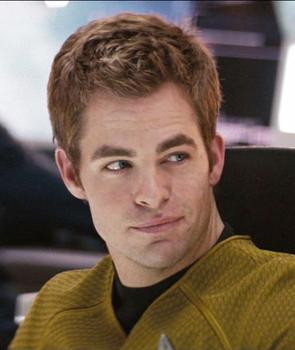
 Kirk avoided choking on his first sip of raktajino, though his face froze momentarily until he could muster up the will to swallow the strong Klingon beverage. “That’s some coffee,” he croaked, casting a smile at DeSalle, whose cup was frozen scant centimeters from his mouth.
KadRiq took a gulp of the Klingon coffee. “Yes,” he replied, “your food slots surprisingly do it justice. Shame we can’t program more Klingon recipes into it, but replicated gagh is just plain nasty.”
“Perish the thought,” Kirk responded, rolling his eyes. “It must be terrible having to eat human food.” The Bridge crew was taking a short meal break in the Mess Hall until the ship was on final approach to the Betreka Nebula, leaving Chekov as the temporary duty officer.
“Why do humans prefer their food dead, Captain?” This from Koloth.
Dr. M’Benga, the only remaining physician on board, fielded the question. “Well, humans ate their food uncooked and sometimes even live a few millennia ago, but cooking was discovered as a way of reducing food-borne illnesses and enhancing flavor.”
“Mmm,” KadRiQ grunted, biting off a chunk of his sandwich, which was made from the breast of a Rigellian Tinga fowl. Wiping a glob of mayonnaise off his lips with the back of his hand, the Klingon captain waved his sandwich before him. “This bird may be dead, but it has a certain flavor. The first time I tried human food, back on Earth, I was disgusted. But after a few weeks, I developed a taste for it.”
“At least we give our food a merciful and quick death, Captain,” Kirk explained. “I hear that Romulans bore their food to death first.”
“Yes,” KadRiQ chuckled, “that is the Romulan way, in cuisine, courtship, and combat!”
“At least we shall not starve to death, Captain,” Koloth added.
The bosun’s whistle shrilled to life, followed by Chekov’s voice. “Bridge to Keptin. Ve are ten minutes away from entering ze nebula.”
Four minutes later, Kirk and his entourage stepped onto the Enterprise Bridge and took their respective stations. “Mr. DeSalle, take us out of warp at thirty light seconds to nebula entry and engage the impulse engines at half speed.”
“Yes, Captain Kirk,” DeSalle answered, making the relevant calculations on his board.
“Kirk, are we just going to walk into the nebula,” KadRiQ demanded. “This is a trap. They know what our entry point will be if we do not change course!”
“You’re right, Captain,” Kirk replied, “and I’m counting on it. However, I expect them to ambush us a little further in, when they’ve got their reinforcements. I doubt they’ll take us on one to one.”
“Sound analysis, my dear Captain Kirk,” Koloth commented.
“Thank you, my dear Commander Koloth,” Kirk replied. The Klingon executive officer was starting to get on his nerves.
“Slowing to half impulse, Captain,” DeSalle reported, as the star field visible through the viewing screen lost its surreal warp effect.
“Very good, DeSalle. Lieutenant Uhura, hail the Pompeii, code two, on viewer. I want to make sure we’re still synchronized.”
“Hailing frequencies opened, Captain,” Uhura replied.
A moment later, the image of a middle-aged man with hazel eyes filled the viewscreen. “Matt Decker here, Jim. Is our plan still a go?”
“It is, Matt. We’ll rendezvous at the agreed-upon point in four hours. Will you be able to get there in time? This nebula’s got an awful lot of turbulence for an Einstein-class ship to handle.”
“We’ll be there, Jim. These Orions have got to be stopped once and for all!”
“All right, Matt, we’ll see you there. We’ll be glad to have your firepower to add to our own.”
“Agreed. Pompeii out.”
Seconds later, the Enterprise entered the swirling, multicolored, interstellar cloud of dust, planetary fragments and ionized gases.
“Bring our sensors up to 110%, Commander Koloth, and sound Red Alert” Kirk ordered.
Koloth’s hands played across Spock’s science station like a concert pianist. “Sensors now at ten points above full power, my dear Captain Kirk. I do believe this ship can see in the dark.” The Red Alert klaxon blared for a few seconds and the ship’s lighting shifted to red.”
“Let us hope that you can as well, Koloth, because if any Orion ships sneak up on us, the only thing you’ll be seeing is my teeth your throat,” KadRiQ rumbled.
Kirk raised his eyebrows, at which KadRiq explained sotto voce. “Kirk, among Klingons, it is necessary to snarl and bare your teeth. If I did not, Koloth or one of my other men would cut out my heart and eat it while he stood over my lifeless body.”
“How do you treat your best officers?”
“That is how we treat our best, Kirk. Koloth is my best friend, yet he would kill me if I showed any sign of weakness.”
Uhura turned to face Kirk. “All decks report battle ready, Captain.”
“Deflector shields are non-functional, Captain,” DeSalle reported. “Phasers are armed and ready, and both forward and aft torpedo bays are loaded.”
“Thank you, Mr. DeSalle. Prepare to change course to 147 mark 63, three-quarters impulse power.”
“Aye, sir.”
“At that speed, Captain Kirk,” Koloth reported, “it will be almost impossible to detect enemy ships until we are upon them – or they us.”
“I’m wagering they won’t expect us to take this course, Commander, but even if they do, it is unlikely more than one of their ships will be in position to do anything about it.”
“Captain,” Uhura cut in, “without shields and running only a skeleton crew, aren’t we in danger of being boarded?”
KadRiQ beat Kirk to the punch. “Lieutenant, their transporters will not work in the nebula, and if they try to grapple shuttlecraft onto the hull, we’ll see them and have our men in position to repel.”
Kirk nodded and smiled, unaware that his course change had been observed by one of the Orion raiders, which even now was tracking the Enterprise from a positive 20,000 meters relative on the Z axis.
