
“Life should begin with age and its privileges and accumulations, and end with youth and its capacity to splendidly enjoy such advantages.”
-Mark Twain
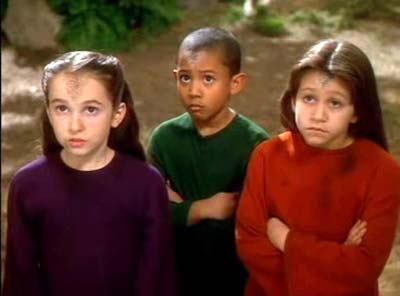
Tuvok’s shuttle crash lands on a moon, where he meets a group of what appear to be alien children who begin mysteriously disappearing one by one.
I have, perhaps, an odd approach to rating Star Trek episodes. Some are excellent all around, and yet they do not resonate with me emotionally. Because of this I find it hard to evaluate them. For “Innocence“, the opposite is true. It is only an average episode, but it strikes a very deep and personal chord within me, and so gives me much to think and write about.
Let me first show you where I feel the episode misses the mark.
The plot is rather drawn out. Picking up the pace would have made it more interesting. It takes the crew too long to discover that Tuvok is missing. It also takes Tuvok too long to realise that there is more to the “children’s” story than meets the eye.
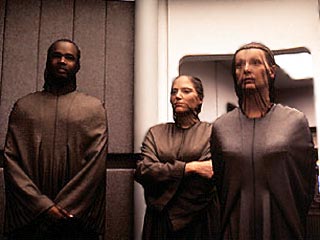 Further, the “adult” Drayans are xenophobic and mercurial, and neither of these characteristics make them very interesting. The spirituality we get at the end of the episode is not enough to compensate. They seem drab and joyless, in stark contrast to the very lively “children”.
But what bothers me most, from a scientific perspective, is the reversed ageing process, which clearly violates the laws of physics. Granted, the same can be said for much of Star Trek, otherwise the series couldn’t tell the stories that it does. Here, however, I find it very difficult to suspend disbelief. According to the Second Law of Thermodynamics, the general course of everything in our universe is from a state of order to one of disorder. The cellular decay that marks biological ageing is but one example of this. Therefore a natural progression from age to youth is biologically impossible.
 In fiction, however, the concept of reversed ageing is nothing new. Two examples come to mind. As early as 1922, F. Scott Fitzgerald, inspired by the above quote from Mark Twain, wrote “The Curious Case of Benjamin Button“, in which a man born old grows ever younger as time passes. In the realm of Star Trek, the Animated Series episode “The Counter-Clock Incident” has the crew pass into an alternate universe and grow younger as time runs backward. From a purely literary standpoint, reversed ageing strikes me as a fitting illustration of how the elderly in our world can become increasingly childlike in mind and spirit as they approach the end of their lives. So perhaps this point really isn’t so negative after all, but rather bears further discussion.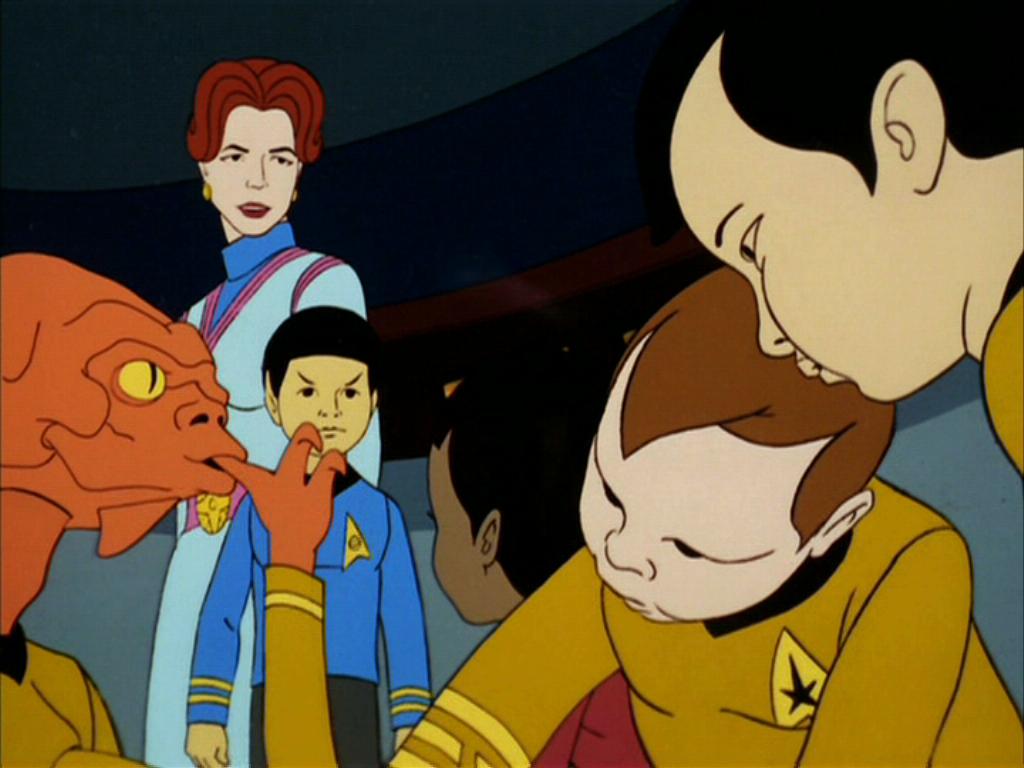
This brings me what makes “Innocence” so meaningful for me.
We see this story through the eyes of Tuvok. Much of what he goes through reminds me of my experiences with my ageing grandmother, and of how I accompanied a close friend, who died of cancer several years ago, on his final journey.
At the beginning of the episode we see Tuvok at the side of a dying Ensign Bennett, a young man who passes away long before his time. Tuvok remains by his side and assures him that he will be remembered and missed. Though this scene is very brief and can in no way compare with my friend’s long battle with cancer, it reminds me of one night just a few days before he passed away. Several other friends and I stood around his bed, sharing stories, praying with him and letting him know how much he had blessed each of our lives.
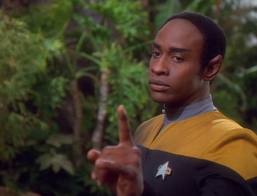 Tuvok’s interactions with Tressa and the other “children” make me think of my experience with my grandmother’s progressive dementia. In the years before she passed away, she became more and more childlike. When visiting her, I would often read her stories, tuck her into bed, pray simple prayers with her, sing her to sleep and generally try to dispel her fears and confusion, just as she had done for my mother and later for me. Occasionally she would have moments of clarity and speak like the 96-year-old she was, telling me how much I reminded her of my mother when she was my age. Tressa’s suddenly adult remarks at the end of the episode call those bitter-sweet memories to mind once more.
I am often ill at ease with children, so I can identify with Tuvok’s initial discomfort. It is heartwarming to watch as he does learn to approach the “children” on their level and open up to them. In so doing, he also shows the viewers more about Vulcan culture, and about himself, which makes him much more real to me. I found his lullaby for the children very touching, and would have loved to have heard some of it in Vulcan.
As the episode draws to a close, the Drayans reveal that the apparent children are in fact of advanced age, and have been brought to this moon in order to pass from this life. However, the caretakers who were to guide them in their final days were killed as their shuttle crashed, leaving the “children” to face death alone and afraid. In looking after them, Tuvok provided the courage and support they needed to pass on peacefully. This is the fruition, I believe, of his experience with Bennett at the start. 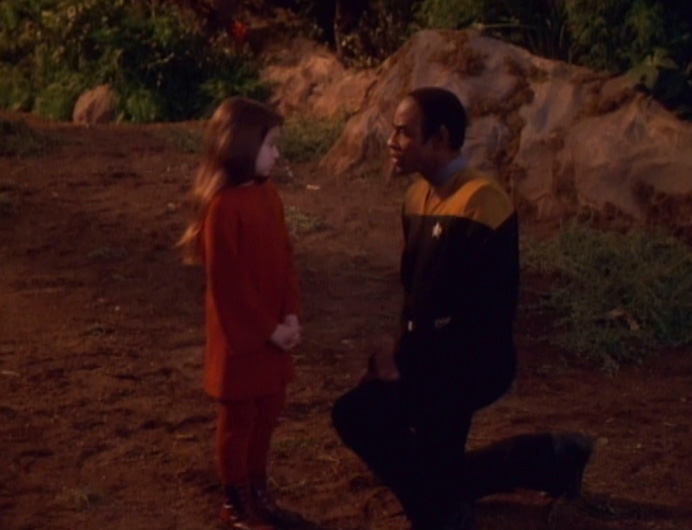
My friend, my grandmother and I shared a faith that allowed them die in peace as well. This same faith lets me know that one day I’ll be with them again. That gave me great comfort in the midst of the grief.
On a lighter note, there are several more things that I enjoy about the episode. The young actors, especially the girl who played Tressa, do a fine job. The “children’s” behaviour seems very natural. It is amusing to see little flashes of irritation from Tuvok. Chakotay gets a bit of character development as he tells Janeway about his diplomatic mishap. The Doctor is excellent, as always, and I like the warning against pursuing technological advancement at the expense of ethics, personal relationships and self-discovery. Granted, we’ve heard that many times before, but the message still holds true.
The faulty scientific premise and slow plot development keep me from giving this episode a top score. Yet it is a poignant portrayal of what it means to age and die with dignity. Addressing such basic questions has always been one of Star Trek’s great strengths, and that is what makes this otherwise unremarkable episode so special to me.
“May this day find you at peace, and leave you with hope.”
– First Prelate Alcia
Very special thanks to Matt Rushing and Colin Higgins for all their advice and support!
This article was inspired by The Delta Quadrant’s Review of “Innocence”.

November 6, 2012
What a beautifully written article. Thank you for sharing such a personal story with us.
November 8, 2012
Thanks, Dave, for your kind words. They mean a lot to me.
November 7, 2012
wow! What an amazing piece.
You are such a kind person. Your personal connection to this episode with your grandmother is very touching.
I think your image selection for this post is really good. 🙂 The whole thing flows so nicely, thank you for writing this.
Also, I think it’s great that Tuvok got a nice episode.
Jeff
November 8, 2012
Hi Jeff, it’s such an honor and pleasure to see that you liked this! I have you guys at Treknologic to thank for introducing me to Trek Mate in the first place. As for the images, Michael Clark (@mclark1701) provided and placed most of them. Colin and especially Matt Rushing (@Mattrushing02) were incredibly helpful with editing tips and comments. So those three deserve a massive thanks! I feel really blessed to know all of you!
November 13, 2012
First of all I’d just like to say this was a fantastic article, and I think that you really did this often-overlooked episode justice. Thank you.
Hitchcock once said that he didn’t make films, he was playing an emotional organ, where hitting the right keys would make people laugh, cry, feel terror or love. Telling an emotional story is always hard, and particularly so in Star Trek, where the fans tend to dwell on the science behind everything. While this episode never quite hit the heights of The Visitor (DS9) or Family (TNG), it still has a lot going for it.
I’m sure many of us know the pain of seeing a loved one age, and the feeling of helplessness is sometimes overwhelming. Everyone involved in this episode deserves credit for tackling a subject that’s often ignored. Their choice of making it a Tuvok episode was perfect, and while it had many flaws, it also had a lot to recommend in it… the most important of those being that it made us FEEL.
This episode touched many of those who saw it, and I’d like to thank Renee for sharing her own story here in reviewing it. This was a wonderful, heartfelt article and I look forward to reading more.
November 13, 2013
I never posted a “Thank You” for this wonderful comment till now. It’s the most lovely one I’ve had to date. These words of praise were what inspired me to go on writing. I can’t tell you how much they’re appreciated!